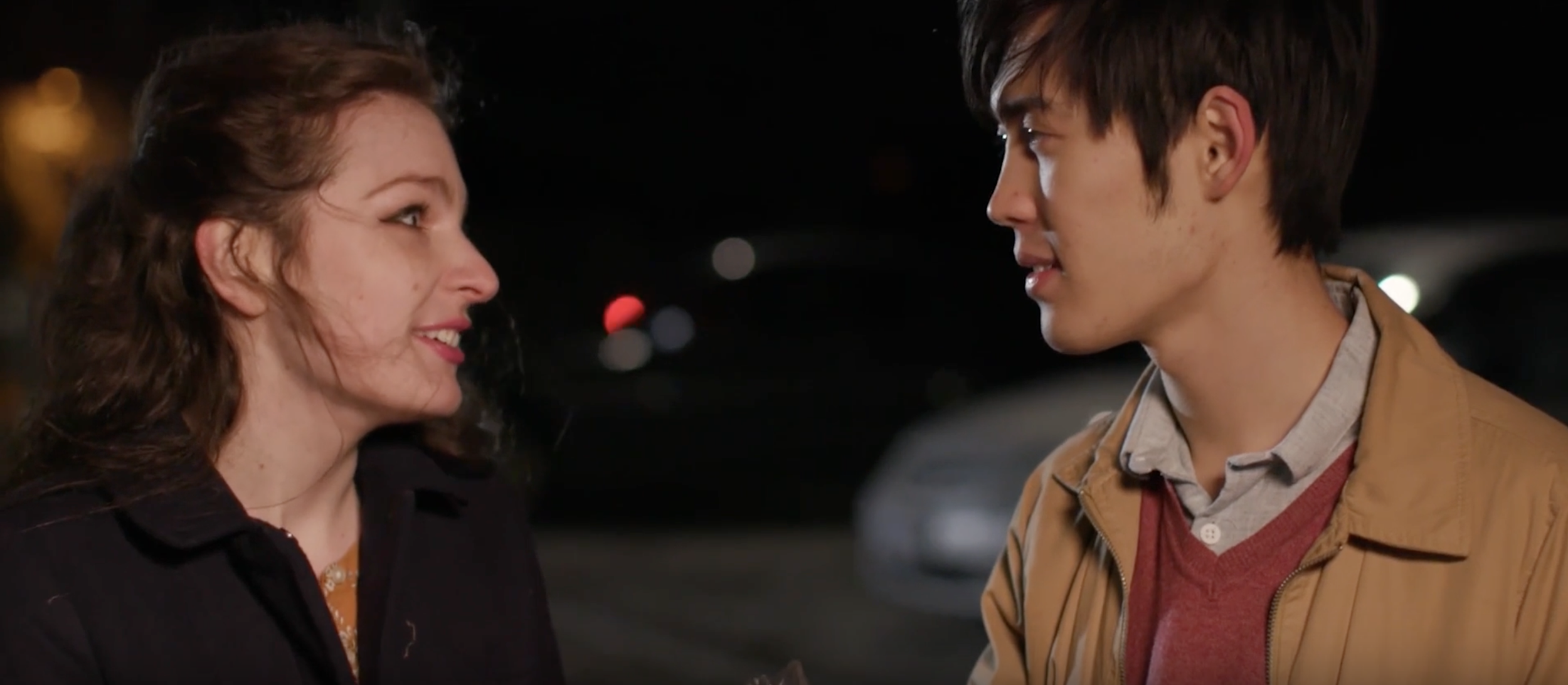
Doug Junior, is my 3rd year 2nd semester project.
I was Director of Photography for this Project and Co-editor.
Doug Junior
Director’s Vision Statement
Doug Junior is an 8-minute romantic comedy told in reverse chronological order. The film follows a doomed relationship between two people who genuinely love each other and all framed around the busy life of a completely ordinary goldfish. Playing on the fable of goldfishes’ short term memories, each scene delves earlier and earlier into the relationship until we arrive at its earliest moment. We learn to love these characters from their quirks and eccentricities, despite knowing their inevitable outcome. The central theme of the film is the need to let go, and for Doug this comes in a couple of ways: he needs to let go of this girl, and to do that he needs to let go of his pet fish and all the memories attached to it.
Blocking
Considering that Doug and Claire are the central characters of the piece, the way the actors are blocked and choreographed from scene to scene will help portray the state of their relationship. They stand closer together or even embrace in scenes where they are happy with each other. In contrast, when the relationship is over or falling apart, they place themselves further away from each other.
Editing/Transitions
Because of the reverse structure of the film, I believe it is necessary to add a scrolling counter between scenes that are separated by large gaps in time. On top of this, scenes will be connected through similar actions by various characters. Ex. One scene ends with a character exiting the apartment, the following scene will open with a character entering the apartment.
Lighting
Because of the gradual shift in tone of the film, from moody to light, this needs to be portrayed through our use of light and colour. In regards to light, the film will be moody and dark in scenes in which the relationship has failed or is failing, and brighter and more cheerful in scenes where the relationship is in a stable state. The only scene that works differently would be the ending – the carnival, which begins slightly dark due to taking place at night, but brightens as the characters step into the lights of the carnival stand.
Colour
There are two prominent colours that will frequently occur in this film: blue and orange. Matching the vibrant colorization of goldfish (and Doug Junior himself), orange and warmer tones represent Doug and Claire’s love for one another. Blue and colder tones will ultimately represent the absence of love, the lack of those original warm feelings that the two once had for each other. Considering the structure of the film, the film will become progressively warmer with each following scene. The midpoint of the film will in turn have an even mix of cold and warm tones indicating Claire’s frustrations with the relationship.
Camera Angles
The film will avoid heavy use of low or high angles, unless a shot is from the perspective of Doug Junior’s fish bowl. Otherwise, the film will generally be from Doug’s eyelevel.
Set Design
Doug’s living space is a direct metaphor for the state of his life and his overall mental well-being. When we first see him, his apartment is a total disaster – trash strewn everywhere, microwave dinner boxes piling up. Doug just doesn’t care about anything anymore. As the film goes further back in time, we find out that Doug actually very much cares for the appearance and state of his apartment. In fact, he loves it so much that he more or less outright refuses to leave his apartment, obviously causing some distress with Claire.
Doug Junior’s overall health is also a direct metaphor for the state of Doug and Claire’s relationship, or lack thereof. When Doug first gets Junior, and sets him up in his fish bowl home, his coloration is a vibrant orange, even more than one would think of a typical goldfish. However, as the relationship falls apart, Junior’s coloration becomes unhealthy and tinged with blue, his bowl becoming an uninhabitable nightmare. Eventually, Doug and Claire end their relationship, and so too does Doug Junior’s life end.
Music
The lightheartedness is derived from Claire and Doug’s funny and sweet moments they share. The witty dialogue drives the film forward but the feelings and undertones of the real problems that come with being in a relationship that is crumbling are all still present, finding humour in the small moments. (ex. 500 days of summer)ost-rock bands like Slowdive, or Explosions in the Sky.
Summary
Doug Jr. is an 8-min romantic comedy, it’s a story about the loss of love between Doug and Claire (through the time span of the life of a goldfish named Doug Jr.) The story is told in reverse chronological order, beginning with the death of the goldfish and ending with Doug winning a gold fish in a carnival game. Doug Jr. is a witness to the story of the young couple, through the good times, however once the relationship starts to go sour, Doug Jr. starts to be neglected and slowly starts to wither away at the same pace as the relationship.
The lightheartedness is derived from Claire and Doug’s funny and sweet moments they share. The witty dialogue drives the film forward but the feelings and undertones of the real problems that come with being in a relationship that is crumbling are all still present, finding humour in the small moments. (ex. 500 days of summer)
The central theme is letting go. Let go of Clair, of Doug Jr, and all the memories attached to it. This story has wholesome moments and is rooted in realistic situations, it’s about two ordinary people who genuinely love each other but their relationship crumbles for outside reasons that are assumed to happen off-screen that put a strain on their relationship.
The story is framed around the goldfish’s life, giving a fly on the wall perspective to Doug ad Claire’s relationship. Doug Jr. the goldfish who will always be present in the scene without necessarily interacting in it. (always present in the fore ground or background of a scene). The rest of the story happens out of the apartment and off screen, audience only gets the snippets into the life of Doug and Claire only from the perspective of Doug Jr, the audience never gets the whole story. The story begins just after the break-up of Doug and Claire (which also happens off screen) each scene after that goes earlier and earlier into the relationship until the audience arrives at the Doug’s and Claire’s first date. Every happy moment feels bittersweet because it’s undercut with the knowledge that Claire and Doug do break up.
DOP Vision Statement
Inspiration
I have drawn inspiration for Doug Junior from:
Movies: 500 Days of Summer (Marc Webb), Annie Hall (Woody Allen), Billie Elliot (Stephen Daldry), LaLa Land (Damien Chazelle)
Tv series: This Is Us, It’s the end of the F*cking world
Music videos: what if I go (mura masa), Don’t delete the kisses (Wolf Alice)
My goal is to tell the story of the story in a realistic way, keeping the lightheartedness and comedy while also keeping the drama undertones present; without undercutting any of the jokes.
Lighting
The lighting will reflect a realistic space, practical’s will be used in most shots. Lighting ratio: 2:1 or 4:1 and will be fairly even, a slightly dialed back commercial look. There will also be a gradual change in light from moody to bright following the tonal shift in the story. The tonal shift will also be told in the colour of the light, starting dark and dim (leaning towards daylight and blue tones) in the scenes where the relationship has failed or is failing. The brighter warmer light and scenes where the relationship is. The carnival will also carry on the idea of conveying the mood through the light by having a 2:1 light ratio, achieved through practical’s. All light will be motivated, and have a natural feel.
(Doug Jr. tank will need to have a practical lamp right next to it, may need to trouble shoot)
Lighting Progression:
Doug Jr. Death, diffused daylight, practical’s in frame but all turned off (moody light) Dinner Scene will be a mix of candle light and “moon light”
Carnival scene will be Orange lit
Colour
The Colour Palette is blue and orange.
While blue and colder tones will represent the loss of love (the warm colours that are present will be faded and dull). Warmer colours will represent Doug and Claire’s love for eachother (more bright colours in the frame, world feels more saturated).
Creating colour contrast in order to add depth to the frame.
Colours for Characters:
Orange ---> Doug Jr.
Yellow ---> Claire
Blue ---> Doug (lighter shades of blue the happier he is) (magenta – one scene where he wears magenta, blue + yellow, when the relationship is going well.)
Camera Angles & Framing
Most camera angles will tend to be eyelevel with Doug, unless it’s a POV shot from Doug Jr. perspective.
Framing will be used to show the distance and closeness of the couple throughout the story. Doug Jr. will consistently be in the foreground and background of shots.
Framing will tend to be centered two shots. Coverage of each scene will be a wide master, medium centered two shot, OTS close up on Doug and Claire. Then inserts (depending on the scene) and singles on Doug Jr.
Framing will start fairly wide while they are broken up, and slowly move closer as we progress earlier into the relationship.
Camera movement will be fairly static, swapping from tripod to easy-rig, Dolly follows in the carnival scene.
Camera Specs
Lenses:
14 will be used for the bathroom scene (due to the cramped space) 24 for the wide shots on the living room and dining room
50 for close ups and OTS coverage
135 for ECU inserts of Doug Jr
Camera Settings:
1920x1080 RGB444 12 bit ISO 800 (or less)
BT 709
(aiming for a shallow depth of field) – F-stop: 2-5.6